What Is an Inner State?

Part I, The Science of the Inner State
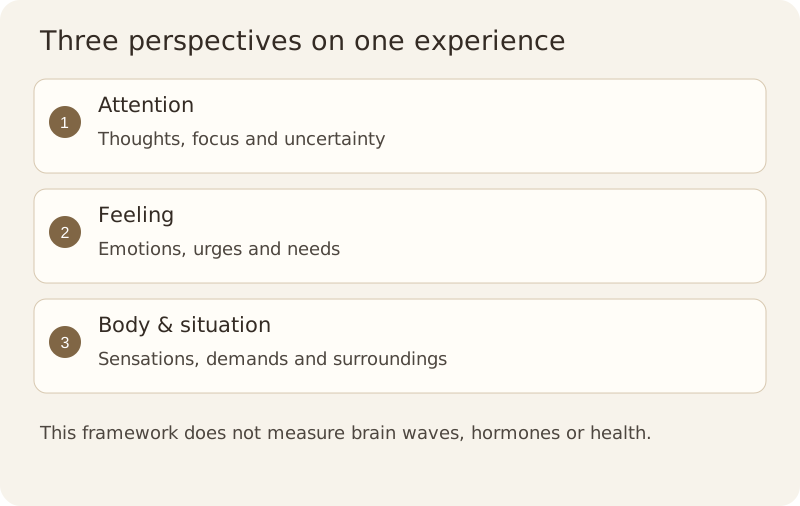
How you feel is related to what happens in your body, what you notice and what you experience. Researchers can measure aspects of this, such as brain activity and heart rhythm. No single measurement captures your whole experience. This chapter introduces some bodily processes involved in feelings.
The brain as an oscillating system
RESEARCHED Hans Berger first recorded human brain activity with surface electrodes in 1924 and described the alpha rhythm. What an EEG measures is not the firing of individual neurons, but the summed postsynaptic potentials of large populations of pyramidal cells in the cortex, which rhythmically move in and out of phase. That synchronization produces oscillations with a power spectrum we divide into bands.
Brain rhythms are often grouped as delta, theta, alpha, beta and gamma for research. The boundaries used vary somewhat. Certain patterns are more common during sleep, attention or movement, but one band does not correspond to one feeling. Measurement location and the task being performed also matter. Frequency alone cannot establish happiness, tension or a level of consciousness.
Lutz and colleagues (PNAS, 2004) found differences in gamma activity between eight experienced meditators and a comparison group. That is an interesting group difference in a small study. An association with practice hours does not establish that meditation caused it, and gamma activity is not a happiness score. The study does not provide a personal training target.
Brain rhythms describe electrical activity in the brain. EEG records associated signals through electrodes on the scalp. These findings do not show that thoughts use a particular frequency to control events outside the body.
Neurochemistry: not “happiness hormones” but systems
RESEARCHED The popular language of “happiness hormones” is misleading. No single neurotransmitter encodes an emotion; they modulate networks, context-dependently.
Schultz’s research on dopamine neurons showed that some of their activity tracks differences between expected and received rewards. Berridge and Robinson also distinguish wanting a reward from enjoying it. Dopamine has several functions; describing it solely as the chemical of happiness, desire or prediction is too simple.
Serotonin (5-HT) modulates mood, satiety, and behavioral inhibition via at least fourteen receptor subtypes. Its importance appears indirectly from acute tryptophan depletion studies (ATD): have subjects drink an amino-acid drink without tryptophan, and the serotonin precursor in the brain drops within hours. In people with depression in remission this often elicits a temporary relapse (Delgado et al.); in healthy people without vulnerability the effect is small, which immediately nuances the simplistic “serotonin deficit = depression” story (see the influential critical review by Moncrieff et al., 2022).
Cortisol participates in the stress response and also follows a daily rhythm. Stress, sleep, illness, medication and the timing of measurements affect its levels. Research on group averages does not provide a simple personal threshold for excessive stress. Both the level and the pattern can matter.
What heart rate variability can and cannot tell us
RESEARCHED HRV is the variation in time between successive heartbeats. Breathing and autonomic control of the heart contribute to it. Heart rate often rises a little during inhalation and falls during exhalation. This is called respiratory sinus arrhythmia.
Measurement method, breathing rate, age, fitness, medication and timing affect the result. Higher is not automatically better. A watch cannot determine whether you feel safe, have experienced trauma or regulate emotions well.
Thayer and Lane’s neurovisceral integration model uses HRV to study relationships between the brain, heart and regulation. It is a research model. When observing yourself, sleep, symptoms and how you feel matter at least as much as a number. Ask a healthcare professional about medical abnormalities.
Embodied cognition: the direction is mutual
Theories of emotion differ in the role they assign to the body. James and Lange emphasised perceiving bodily changes. Later work by Damasio, Critchley and Barrett, among others, examines relationships between bodily signals, prior experience and interpretation. These theories are not interchangeable or definitive explanations of every feeling.
The interaction is especially interesting in practice. A walk or a change of posture may sometimes influence your experience. That effect needs to be considered in its setting; a general theory does not tell you which exercise will help you.
The state as a regulatory system
An inner state can be described from several perspectives. They are related, but they do not form a dashboard with separate happiness controls. A small change in your day is an experiment whose outcome you still need to observe. Not noticing a difference is information too.
The next chapter uses a simple model to explore these interactions. We then look at music, food, movement, breathing, light and social circumstances.