Breath and the Nervous System

Breathing usually happens automatically, and you can also adjust it consciously. Research links breathing rate to heart rate, and some exercises may help with tension. That makes breathing worth exploring without expecting one technique to work for everyone.
The vagal brake: RSA and the mechanism of the long exhale
RESEARCHED Heart rate changes during the breathing cycle. The vagus nerve and other regulatory processes contribute to this. Slower breathing can increase HRV and affect heart rate. This does not mean that every longer exhale signals safety to the brain or always increases average vagal activity. Breathing rate, depth and measurement method matter.
The resonance frequency: why ~6 breaths per minute
RESEARCHED The cardiovascular system has a mechanical resonance around 0.1 Hz (≈6 cycles/minute), determined by the delay in the baroreflex loop. If you breathe at that frequency, the breath-driven heart-rate oscillations come into phase with the baroreflex oscillations, and a resonance peak arises with maximal HRV amplitude (Vaschillo, Lehrer et al.). This is the basis of HRV resonance-frequency biofeedback: train people at their individual resonance frequency (usually 4.5–6.5/min) and HRV and baroreflex gain rise. The meta-analysis by Goessl, Curtiss & Hofmann (Psychological Medicine, 2017; 24 studies) found a large effect of HRV biofeedback on stress and anxiety (Hedges’ g ≈ 0.8); Lehrer et al. (2020) replicated effects across a range of outcomes. The “magic number 6” is thus not mystical but control engineering: you tune to the natural frequency of a biological control loop.
What research on cyclic sighing shows
RESEARCHED Balban and colleagues (Cell Reports Medicine, 2023) compared five minutes of daily breathing exercises with five minutes of mindfulness over a month. The exhalation-focused cyclic sighing group showed improvement in positive mood. This was a small study using self-reports. It does not establish that one to five sighs instantly reset mood, that this is the fastest technique or that it treats trauma symptoms.
Breathing steers the brain, not only the heart
RESEARCHED Two findings lift the breath from “relaxation trick” to “neuromodulator.” First: Zelano et al. (Journal of Neuroscience, 2016) showed that nasal breathing entrains limbic oscillations, the breath cycle modulates theta activity in the piriform cortex, amygdala, and hippocampus via the olfactory bulb. Concrete consequence: subjects recognized fearful faces faster and remembered better during nasal inhale than during exhale or mouth breathing. The phase of your breathing modulates your emotional and memory processing.
Second: Yackle et al. (Science, 2017) identified in the preBötzinger complex (the breath-rhythm generator in the brainstem) a cluster of ~350 neurons that projects directly to the locus coeruleus, the noradrenergic alarm center that drives arousal and wakefulness. Switching off this cluster in mice made them calm without disturbing breathing. This is the anatomical cable between breath tempo and arousal: slow breathing dampens noradrenergic stimulation. Melnychuk et al. (2018) linked this in humans to attention (the “breathing-LC-attention” axis). The review by Zaccaro et al. (Frontiers in Human Neuroscience, 2018) summarizes: slow breathing (<10/min) shifts the autonomic balance parasympathetically and goes with increased alpha and decreased theta EEG power and subjective calm.
The evidence that mind steers the immune system: Kox 2014
RESEARCHED Kox and colleagues (PNAS, 2014) studied training combining breathing, cold exposure and concentration in healthy volunteers. During a controlled endotoxin experiment, adrenaline and inflammatory responses differed between the trained and comparison groups. The experiment took place under medical supervision. It does not show that thoughts cure disease, and the findings do not directly transfer to people with medical conditions or unsupervised practice.
The old precursor, measured again
PHILOSOPHY Tummo is a Tibetan practice combining breathing and visualisation. Studies by Benson (1982) and Kozhevnikov (2013) described temperature changes in small groups of practitioners. This examines a particular practice; it does not validate every traditional explanation. We do not provide instructions for forced breathing or breath retention here.
The polyvagal lens, honestly labeled
PROVISIONAL Polyvagal theory places safety and connection at its centre. Its evolutionary and neuroanatomical explanations are disputed. Vagal function and changes in HRV do not in themselves validate the whole theory. Part II discusses the distinction between a recognisable metaphor and a tested mechanism.
A simple exercise
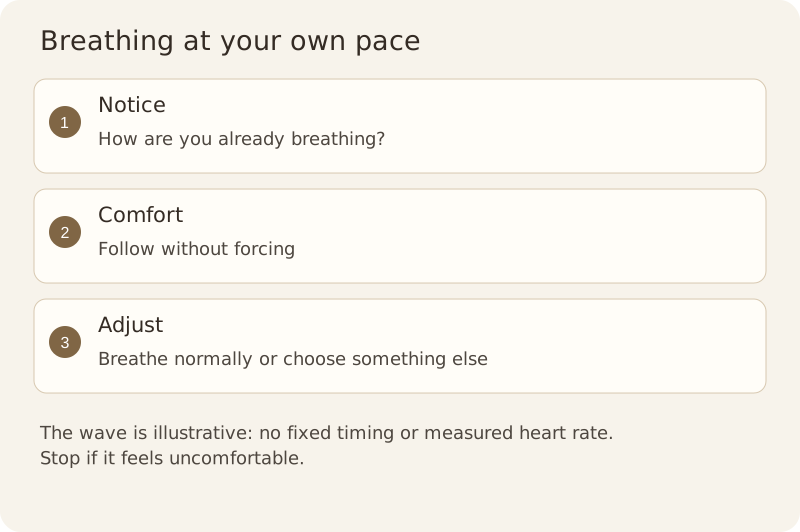
Sit comfortably and notice your natural breathing for half a minute. If that feels comfortable, let your exhale last a little longer without forcing it or taking unusually deep breaths. Drop any imposed pace if you feel short of air. After a minute, notice whether anything has changed. You do not have to become calm.
When to stop
Stop if you feel dizzy, short of breath, tingling, pain or growing distress, and return to normal breathing. You can focus on the room or skip the exercise. Practise only somewhere an unexpected reaction would not create danger, never while driving, swimming or operating machinery.
Forced breathing and breath holding can cause fainting, especially in combination. Never do them in or near water. They are not part of this book’s exercises. Discuss breathing exercises with a healthcare professional if you have breathing or heart problems, or if they trigger panic.
The next chapter considers light, daily rhythm and surroundings.