The Inner-State Cycle

A poor night’s sleep can make a difficult conversation harder. That conversation may then disturb your sleep. Many people recognise interactions like these. The Inner-State Cycle is our way of drawing them clearly. It is a teaching model, not a validated explanation of depression or recovery.
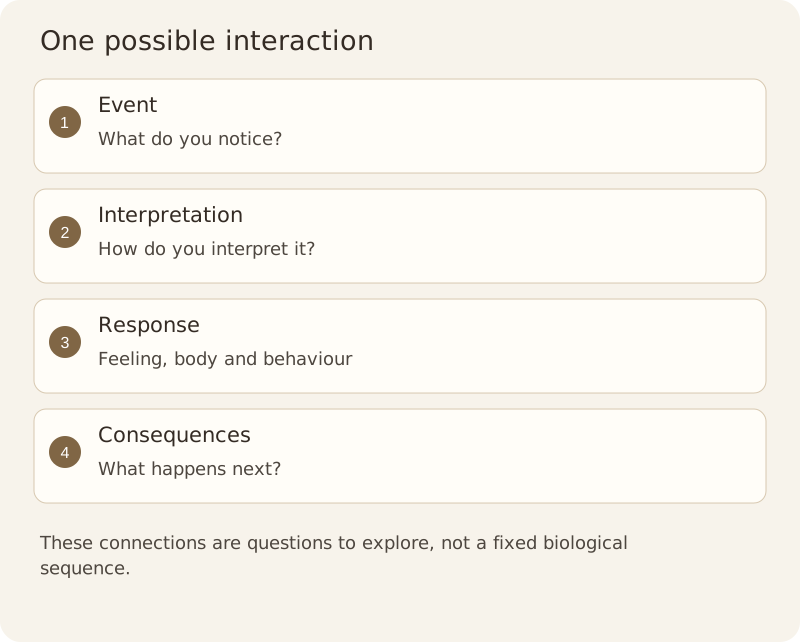
I call this model the Inner-State Cycle. It consists of five links.
The five links
   [1] INPUT  -->  [2] BRAIN  -->  [3] CHEMISTRY  -->  [4] BODY
   (sound,         (perception,    (dopamine,         (HRV, posture,
    food,           meaning,        cortisol,          energy,
    clothing,       attention)      serotonin)         presence)
    light, people)                                       |
        ^                                                v
        +------------  [5] ENVIRONMENT / SOCIAL  <---------+
                       (responses from others,
                        which again form your input)
Link 1, Input. Everything that enters your system: the sounds you hear, the food you eat, the light that falls on you, the clothes against your skin, the touches, the people you talk with. Inputs are the raw material of your state. And the decisive insight: of all the links, this is the one you have the most direct access to. You cannot simply change your feeling, but you can put on a different playlist, open a window, eat something else, walk into a different room.
Link 2, Brain. The input is not passed on raw; it is interpreted. Your brain hangs meaning on it, directs attention to it or not, places it in a story. The same rain can be “gray and depressing” or “soothing to listen to.” This link is why the input alone is never the whole story: it also depends on how you read it. Here the thinkers of Part II take hold later, Stoicism, Byron Katie, Tolle, who all say: between the stimulus and your suffering sits your judgment.
Link 3: bodily processes. Perception and emotion involve several hormones, neurotransmitters and brain networks. Threat does not simply equal cortisol, reward dopamine and connection oxytocin. These relationships depend on the person and context; this model does not measure them.
Link 4: body and behaviour. When tense, you might clench your jaw, speak faster or avoid contact. Pain, illness and tiredness can also affect how you think and respond. These are interactions, not a fixed sequence.
Link 5: surroundings and relationships. Your behaviour can influence how others respond. Their behaviour is also their own and is shaped by many other factors. This model never makes someone responsible for rejection, abuse or another person’s choices.
Why it is a cycle, and why that changes everything
The crucial word is cycle. This is not a straight line from cause to effect, but a loop that feeds itself. And a loop that feeds itself can turn two ways.
In the downward direction it works like a trap. Grief (chemistry) makes your posture hunched and your gaze dull (body). That closed presence makes people leave you alone or withdraw (environment). That isolation becomes your new input, which your brain interprets as “I am alone, no one sees me” (brain), which deepens the grief (chemistry). Each round makes it a little worse. This is exactly how a dip can become a depression: the loop turns, and turns, and pulls itself down.
You can try changing one manageable part of the pattern: a break, a meal or contact with someone you trust. Sometimes that helps; sometimes little changes. You do not have to force an upward spiral, and a small step being insufficient is not a personal failure.
The evening in the prologue prompted us to develop this model. The atmosphere changed after the music changed. We did not measure brain activity, hormones or heart rate. The story describes what we noticed, not the biological chain that caused it.
The boundary of the model, and the bridge to Part II
The cycle can help you explore an everyday pattern. It does not explain why someone grieves or how depression should be treated. Relationship loss, illness or unsafe living conditions often require more than a different habit. Part II therefore also considers connection, boundaries and meaning.
For now, we stay with everyday possibilities. Music comes first: easy to try, with effects that vary greatly between people and situations.
Use the diagram as a reminder. Choose one change and observe what happens. A model is useful only while it leaves room for experiences that do not fit the diagram.