Light, Rhythm, and Environment
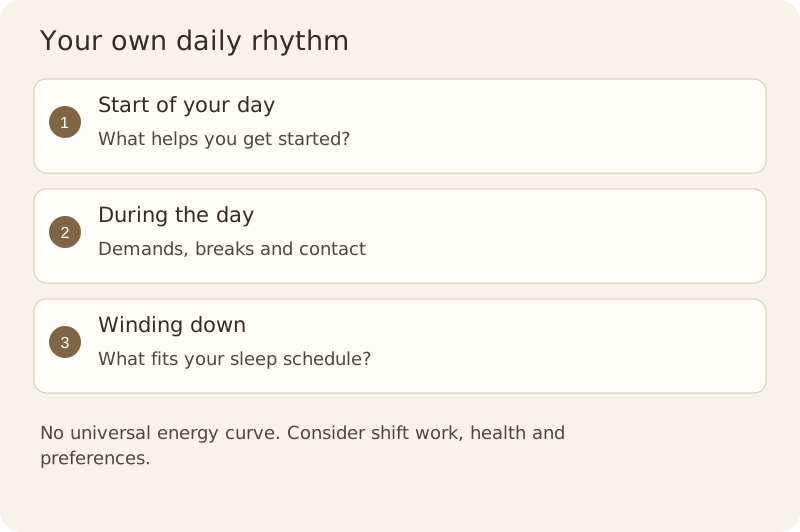
How much light you see, when you sleep and whom you spend time with can shape your day. Research helps explain some of these relationships. It does not provide one daily schedule that is best for everyone.
The photoreceptor that makes no image: melanopsin and the ipRGC
RESEARCHED Alongside rods and cones, Berson, Hattar, and Provencio around 2002 discovered a third class of photoreceptors: the intrinsically photosensitive retinal ganglion cells (ipRGC), which contain the photopigment melanopsin. They do not contribute to image formation but measure ambient brightness, with peak sensitivity around 480 nm (blue). Their axons run via the retinohypothalamic tract straight to the suprachiasmatic nucleus (SCN) in the hypothalamus, the central clock. The SCN synchronizes (entrains) to the light signal and, via the pineal gland, steers melatonin release: light suppresses melatonin, dark releases it. This is not lifestyle advice but measured neuroanatomy: a direct, specialized cable runs from your eye to your biological clock.
Dose and timing: the numbers
RESEARCHED Outdoors is usually much brighter than indoors, even on cloudy days. Effects on the body clock depend on timing, duration, intensity and your own daily rhythm. Morning light can move the clock earlier and late-evening light can delay it, but shift work and sleep disorders require different considerations. Screen use also affects sleep through content and delayed bedtime, not only blue light.
Light as antidepressant: the meta-analyses and a surprise
RESEARCHED Light therapy has been studied in seasonal and non-seasonal depression, including by Lam and colleagues (2016). Treatment with a specialised lamp is different from an outdoor walk. Do not treat research doses as a personal medical prescription. Discuss light therapy with a healthcare professional, especially with bipolar symptoms, eye conditions or medication affecting light sensitivity.
Nature: real effect, partly understood mechanism
RESEARCHED White and colleagues (2019) found an association between at least two hours a week in nature and better reported health and wellbeing in a large survey. People were not randomly assigned a dose of nature. Two hours is therefore not a proven treatment threshold. Other studies examine attention, stress and movement; the contribution of each is not fully understood.
Emotional contagion: the mechanism and the limits
RESEARCHED Emotional contagion is well documented (Hatfield, Cacioppo & Rapson, Emotional Contagion, 1994): we unconsciously synchronize facial expression, voice, and posture with others (measured with facial EMG: looking at a happy/angry photo activates within milliseconds one’s own zygomaticus/corrugator) and thereby feel along. The mirroring mechanism is partly linkable to motor resonance. At network scale Christakis & Fowler (BMJ, 2008) showed in the Framingham cohort that happiness clusters and spreads up to ~3 steps through social networks, though that observational work has been criticized for confounding (homophily: happy people seek each other out) and must be read carefully. The controversial Facebook experiment (Kramer et al., PNAS, 2014, ~689,000 users) showed that manipulating the emotional tone of the news feed shifted people’s own posts in the same direction, evidence for contagion even without direct contact, but ethically fiercely criticized.
A tense environment can be draining. Consider manageable changes in contact, expectations or where you rest. Not everyone can choose their home or working conditions. With threats or abuse, practical safety and help matter more than learning to tolerate the atmosphere.
“Feeling the energy of a room”, exactly explained
PROVISIONAL Quick impressions may reflect tone of voice, posture, facial expression and earlier experiences. They can be useful, but also distorted by fear, bias or incomplete information. Research on thin-slicing does not show that you instantly know what someone feels or intends. Take your experience seriously and check your interpretation when it is safe to do so.
Practice, evidence-based
Try spending some time outdoors during the day if that is possible. Never look directly at the sun. Choose a time and duration that suit you, and notice your sleep and mood. Consider relationships too: with whom can you speak without constantly monitoring every word? There is no required light dose or social success target.
That brings Part I to a close. You have explored several possibilities, supported by evidence of varying strength. Feel free to choose one and leave the rest. Part II continues with relationships, boundaries and meaning in wellbeing.