The Body and Clothing

This chapter is a test case for intellectual honesty. The claims about posture, facial expression, and clothing belong among the best-known of popular psychology, and among those hardest hit by the replication crisis. Here we do what self-help books rarely do: we separate what the large replication studies left standing from what they overturned, and we keep only what the evidence bears.
Embodied cognition: the strong framework
RESEARCHED That body and cognition are intertwined is not a contested fashion but an established framework (Barsalou; Niedenthal). Interoception, the perception of internal body signals via the insula, is measurably linked to the intensity of emotion (Critchley, Garfinkel: heartbeat-detection accuracy predicts anxiety intensity). The brain constructs emotion in part from bodily state (Barrett). The direction of cause thus demonstrably also runs from body to mind. The question is not whether this principle holds, but which specific interventions have a reliable effect.
Facial feedback: an instructive crash and a nuance
RESEARCHEDPROVISIONAL The facial-feedback hypothesis (your facial muscles feed your feeling) was made famous by Strack, Martin & Stepper (1988): subjects who held a pen between their teeth (smile muscles active) found cartoons funnier than those who held the pen on their lips. In 2016 a large-scale Registered Replication Report failed (Wagenmakers et al., 17 labs, ~1,900 participants), the effect disappeared. This became a symbol of the replication crisis.
But the story does not end there, and that is instructive. Coles, Larsen & Lench (Psychological Bulletin, 2019) did a meta-analysis of 138 studies and found that facial feedback does have a small but reliable effect, provided you use the right conditions and do not overclaim the effect. The large Many Smiles collaboration (Coles et al., Nature Human Behaviour, 2022, 19 labs) confirmed a small effect of consciously mimicking a smile on mood, but not with the pen procedure. Conclusion: the effect is real but small and fragile, not the robust lever popular books made of it.
Botox: the sharpest test of direction
RESEARCHEDPROVISIONAL If facial muscles give feedback, then paralyzing them should dampen emotion. That has been tested exactly. Paralyzing the frown muscle (corrugator) with botulinum toxin reduces the blood-oxygenation response in the amygdala when imitating angry faces (Hennenlotter et al., 2009). And in two small RCTs (Finzi & Rosenthal, 2014; Wollmer et al., 2012) one frown-paralyzing Botox injection reduced depressive symptoms significantly more than placebo. The evidence is limited (small groups, blinding complicated by cosmetic effect), hence the partial status, but it is a striking independent argument that the body→emotion direction truly exists.
Posture: modest but still standing
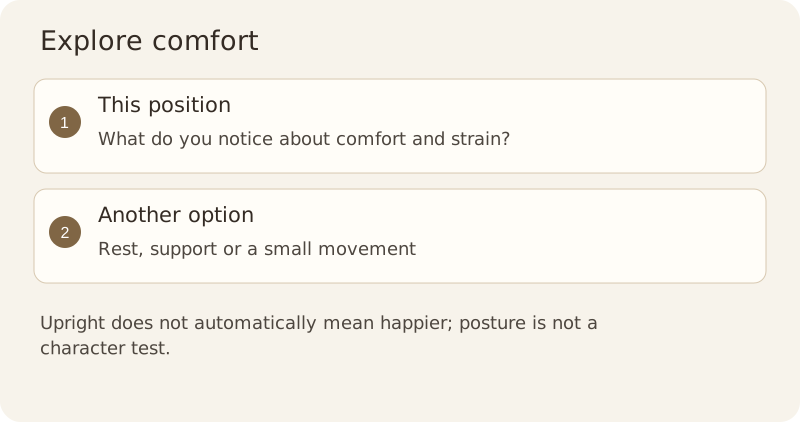
PROVISIONAL Studies by Nair (2015) and Wilkes (2017) examined upright versus slumped sitting during stress or depressive symptoms. Some outcomes, including reported energy, differed between groups. The evidence is limited and does not make posture a treatment. Choose a comfortable position that suits your body; sitting upright is not an obligation.
Power posing: what fell and what remained
PROVISIONAL The original claim (Carney, Cuddy & Yap, 2010) was that two minutes of a “power pose” raises testosterone and lowers cortisol. The larger replication by Ranehill et al. (2015) and a p-curve analysis found no reliable hormone effect; co-author Dana Carney publicly distanced herself from the hormonal claim. What remained in later analyses (Cuddy, Schultz & Fosse, 2018; Gronau et al.) is a more reliable subjective effect: people feel more powerful (“felt power”), with weaker and contested behavioral evidence. The lesson: the hormone story was wrong; the feeling effect is real but modest. Sell it as the latter, not the former.
Clothing: enclothed cognition, with the right measure
PROVISIONAL Adam & Galinsky (2012) introduced “enclothed cognition”: the same white coat improved attention performance more when labeled a “doctor’s coat” than a “painter’s coat”, the effect depended on the symbolic meaning, not the fabric. Direct replications are mixed (some succeeded partially, others not), so we stay cautious. The underlying principle, that clothing meaning steers self-perception and behavior via priming of a social identity, fits within the broader, robust embodiment framework, even if the specific coat effect is small and variable.
Movement: here the evidence is strong
RESEARCHED Research, including reviews by Schuch (2016) and Singh (2023), suggests that exercise can reduce depressive symptoms. Studies differ in participants, supervision and type of activity. This is not a direct comparison showing that exercise will work as well as medication or therapy for an individual. Sleep, enjoyment and social contact may also contribute. Suitable activity and support matter more than training as intensely as possible.
The deeper layer: the body after trauma
PROVISIONAL Tension, tiredness and vigilance can persist after distressing experiences. Some people benefit from movement or body-oriented support; others find attention to the body upsetting. Posture cannot tell us whether someone has trauma. Exercises may be adapted or skipped. Persistent symptoms deserve support from a qualified healthcare professional.
Practice, honestly weighed
Choose a small, manageable change: some movement if possible, a different sitting position or comfortable clothing. Notice what it offers. Disability, pain or fatigue call for adaptation, not more discipline. There is no correct presence or appearance you must achieve.
Next we look at breathing, which usually happens automatically and can sometimes be adjusted consciously.